Hiking is a big part of our visits to National Parks. It’s really hard for me to know about a trail and not hike it, especially if it seems doable and like I won’t get another chance anytime soon. We pace ourselves, we make sure we aren’t overtaxing ourselves with multiple strenuous or long hikes each day, but we’ve been known to rack up 10+ miles in a day just exploring shorter trails. Call it a 1-mile loop and you can bet we’re taking it.
I feel like we had pretty good coverage in hiking the majority of Yosemite, and that’s before we ever even hiked the Half Dome!
Below are the major hikes we completed during our visit, along with one trail we didn’t do, but would love to on a future trip.
Disclosure: This post contains affiliate links. If you click and make a purchase, I may earn a small commission at no extra cost to you. Thanks for supporting my blog!
Wawona Swinging Bridge
Let me start by saying that there are two bridges in Yosemite National Park that claim to “swing,” but this is the only one that actually does. There’s a bridge in Yosemite Valley called the “Swinging Bridge,” but calling it that is a bald-faced lie!
So if you want to walk along a truly “swinging” bridge, this is the one.

I actually knew this going into our trip, and I wanted to swing on a bridge, dang it! So this was actually the first thing we did on our first full day in Yosemite, the same day we visited the Mariposa Grove.
It’s not much of a hike, but I also wouldn’t consider it a low-effort activity due to the longer drive to get there, and the mini adventure it can be actually finding it. This is another one of those spots that you should not rely on Google Maps to find. Rather than following Google Maps directions, just take the Forest Road all the way to the end to get to the trailhead.
The trail is probably less than a mile roundtrip with minimal elevation gain. Plan to spend 20-30 minutes overall. It was not crowded at all, there was only one other family enjoying the bridge. It’s fun to walk along and take pictures, but the destination itself is nothing spectacular. Yosemite has much more impressive things to offer.
That being said, it’s a fun stop if you are already on your way to the Mariposa Grove.
Taft Point
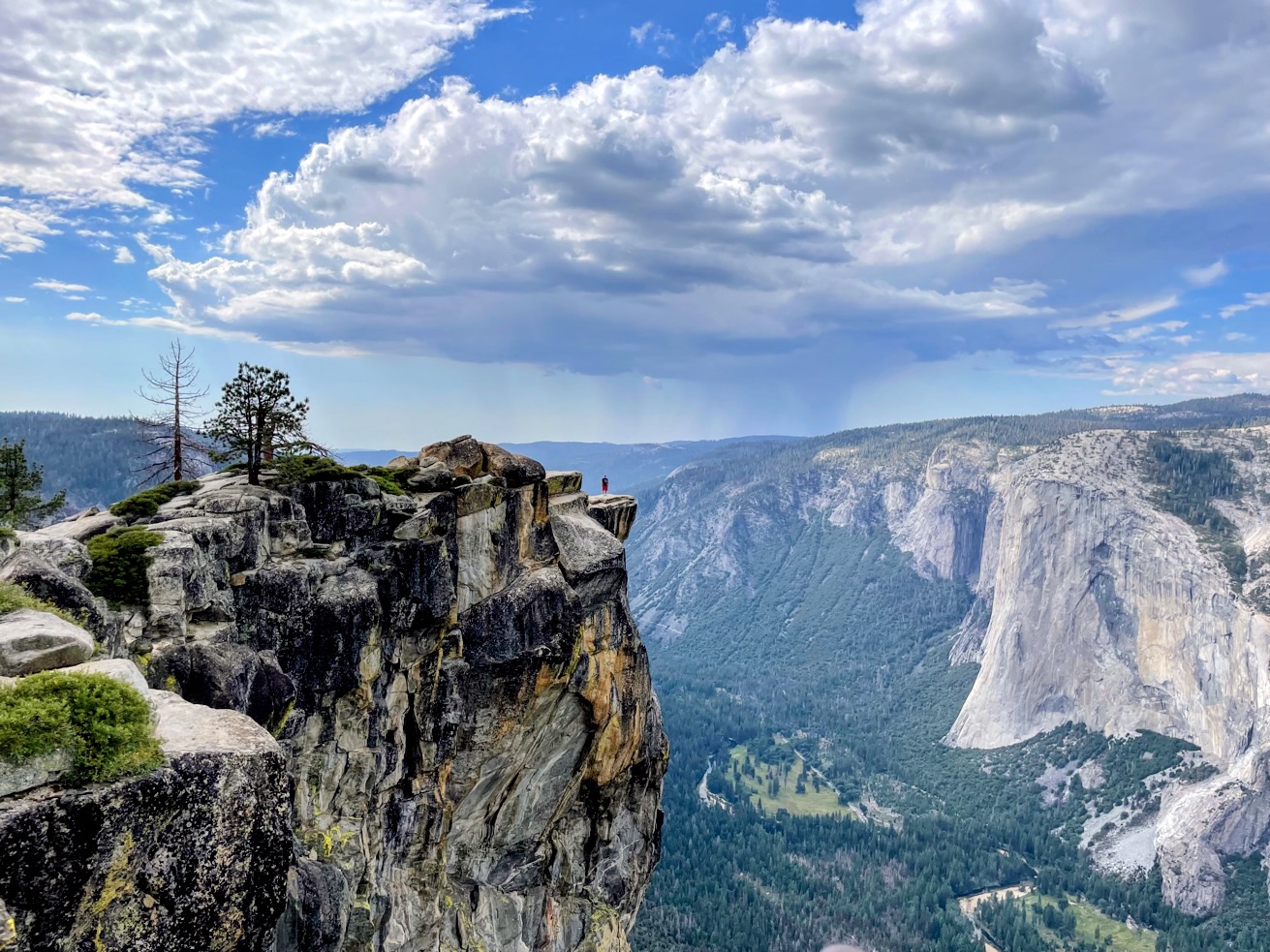
This hike is pretty gosh darn impressive.
The trail is relatively easy, and what a payoff! The trail is about 2.2 miles round trip with an elevation gain of about 250 feet. Plan to spend a couple hours hiking and enjoying the destination. To get there, drive along Glacier Point Road and park at the Taft Point/Sentinel Dome Trailhead.
Taft Point offers dramatic cliff-edge views of Yosemite Valley—without the crowds you’ll often find at Glacier Point.

The hike itself is straightforward, but the final viewpoint sits right along the edge of a massive drop-off. The hike is also known as the Taft Point & Fissures trail. The fissures are deep cracks in the rock, and some of them you could probably fall in if you aren’t careful.
Also, there are no guardrails at most edges. Keep that in mind if that’s the kind of thing that might freak you out. I mean, I don’t consider myself to be especially afraid of heights, but it definitely kinda freaked me out.

Definitely give it a try, it’s a hike that is adventurous without being exhausting. You’ll see I completed the hike in my Croc Flops– this hike is Croc Flop approved.
May Lake
We hiked to May Lake on the day we were exploring Tioga Road. It was pretty quiet, and it’s at a much higher elevation (about 9200 feet). It’s about 2.4 miles round trip with an elevation gain of about 500 feet. It’ll take a couple hours from start to finish. Turn onto May Lake Road off of Tioga Road to get there.
May Lake was one of the quieter hikes we did, though there was what appeared to be a Boy Scout group at the destination taking advantage of what used to be a Sierra Club hot spot. There were the remains of what was once a bustling campsite.
May Lake was once part of the historic High Sierra Camp system operated by the Sierra Club, an environmental organization founded by John Muir. These camps allowed visitors to explore Yosemite’s backcountry long before modern backpacking became common. The cabins at May Lake were build in the early 1900s and used as guided wilderness lodging.
The campground is next to a beautiful alpine lake surrounded by granite peaks. It was a really beautiful spot and we were somewhat jealous of the group that was planning to spend the night.

As we started our way back, we crossed paths with a Park Ranger who had been doing some surveillance at May Lake and was on her way back. We chatted with her the majority of the way down and enjoyed learning about the day in the life of a park ranger.
McGurk Meadow Trail
This is another hike accessible by driving the Glacier Point Road. Park at the McGurk Meadow trailhead. It’s an easy hike, about 1.8 miles roundtrip with an elevation gain of about 150 feet.
The draw for this hike was the promise of an old cabin. The McGurk Cabin was built in the late 1800s by James McGurk, an early settler who used the area for seasonal grazing and homesteading. Today, the cabin offers a glimpse into Yosemite’s pre-National Park history. And let me say, with the way the cabin has sunk, you either have to be very short or crouch to get inside. Chris was definitely too tall, but I had some fun in there.

In addition to the opportunity to explore this old cabin, you also get to enjoy forest scenery and wide-open meadows. It’s very peaceful, I don’t think we ever ran into anyone while exploring the area.

Yosemite Valley / Cook’s Meadow
We saved this area for almost last. Our last full day in Yosemite was spent hiking the Half Dome, so the day before that we intentionally had a low-effort day. To be honest, I should probably count this as more of a low-effort activity than a hike, but it does involve walking at least 1 mile if you do the loop trail. That loop trail can easily be extended into more, but the whole area has minimal elevation gain. Plan to spend maybe an hour exploring the loop trails in Yosemite Valley.

This is one of the easiest and most iconic walks in Yosemite.
Cook’s Meadow sits right in the heart of Yosemite Valley and offers incredible views in every direction. Park near Yosemite Valley Visitor Center and follow the paved paths through the meadows.
This short and easy walk will get you views of the Half Dome, Yosemite Falls, Glacier Point, and Sentinel Rock.
For maximum views with minimal effort, this is hard to beat.
Tuolumne Meadows / Soda Springs and Parsons Lodge
I’ll be honest upfront – this was probably our least favorite hike. It’s just not the stunning scenery we’d come to expect of hikes in Yosemite. Its draw is the naturally carbonated water at Soda Springs. We were excited to see the water bubbles, but it was underwhelming.

There’s also a historic stone cabin called Parsons Lodge. This lodge was used by early conservationists and scientists as a base for studying Yosemite’s natural environment and educating visitors about wilderness preservation. I”m guessing part of their interest in this spot was because of the unique bubbling water.
This is another easy hike, about 1.5 miles round trip with minimal elevation gain. Plan to spend 30-45 minutes there. To get there, park at the Tuolumne Meadows Visitor Center and follow the flat trail across the meadow.
A Hike We Didn’t Do (But Want to Next Time): The Pohono Trail
Since we were already planning a really long and strenuous hike (the Half Dome), we stayed away from hikes that were long and difficult. That being said, of all the longer hikes we read about, it was the Pohono Trail that caught our attention.
Partly because of our stop at the Tunnel View – you could see a trail above that looked quite enticing to me, but in researching I found it was part of the Pohono Trail.
The Pohono Trail runs along the rim of Yosemite Valley, connecting Tunnel View to Glacier Point. It’s about 13 miles with an elevation gain of roughly 3,700 feet – a definite commitment. You can start at either Tunnel View or Glacier Point. We were so enchanted by Glacier Point Road that the idea of hiking the entire trail and seeing all the viewpoints in one journey sounded exciting. Most people do this as a one-way hike and get someone to pick them up on the other end.
Which Hikes Are Best?
Taking the Half Dome and sequoia groves out of consideration, our favorite hikes were definitely Taft Point and May Lake. Both delivered incredible scenery in different ways, and neither required an all-day commitment.
Up Next
In the next post, I’ll share the low-effort activities in Yosemite—the places where you can experience the park’s beauty without committing to a full hike. As much as we love hiking, some of the best Yosemite adventures don’t require any gear.
Enjoyed this post? Subscribe below to get new posts by email!
Click here to see all posts related to the 4-National Park Road to the Half Dome!

Leave a Reply